Oversize permits and escort vehicles
Any load wider than 102 inches (8 ft 6 in), heavier than 80,000 lb gross, or taller than the state's height limit (13 ft 6 in to 14 ft 6 in in most states) needs a permit from every state on the route, and wider loads also need escort vehicles. In Texas a single-trip permit costs $60, plus a highway maintenance fee of $150 to $375 for loads over 80,000 lb.
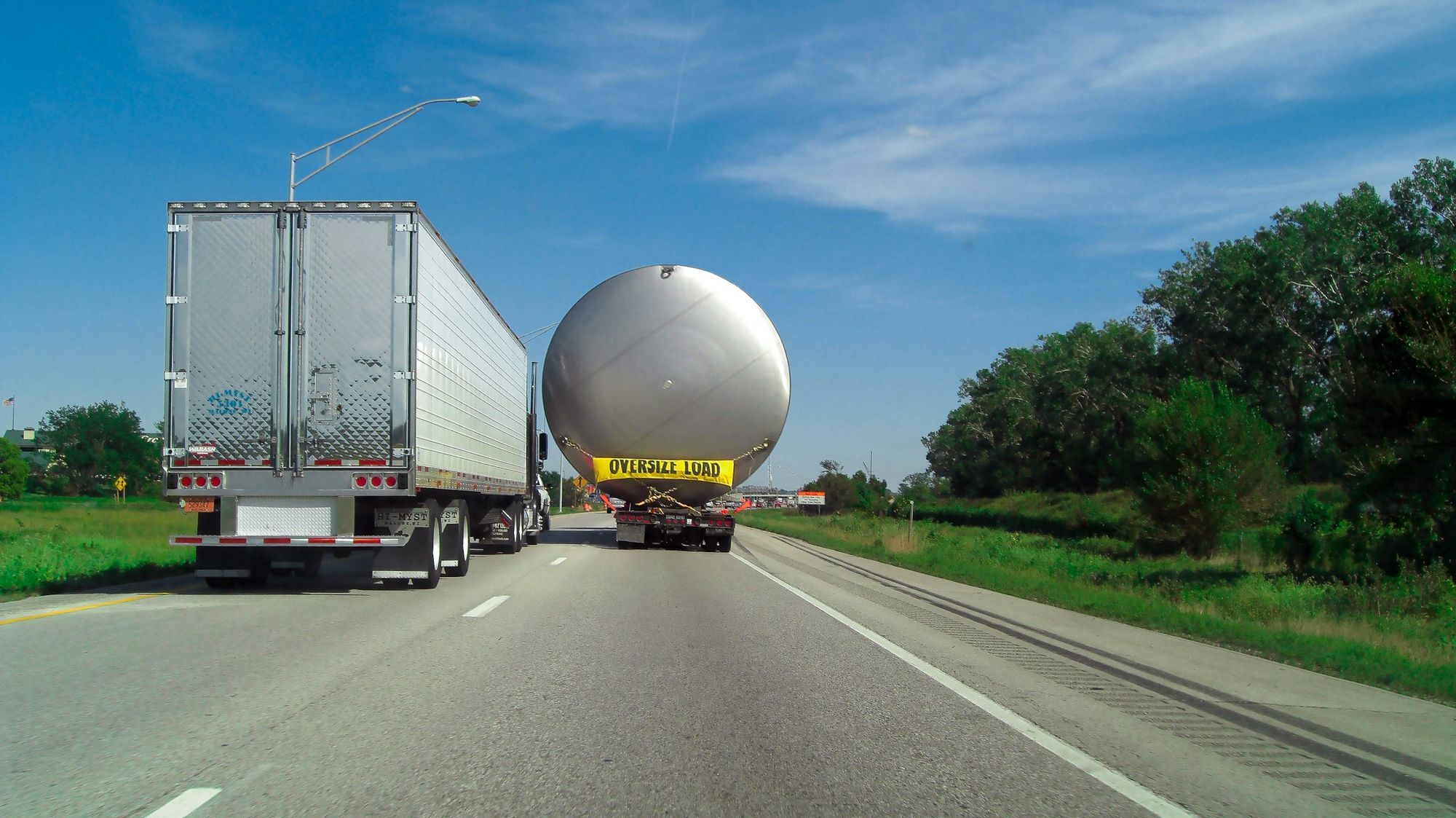
Most freight fits inside the legal size and weight limits and needs no special paperwork. Manufactured homes, modular sections, large tanks, machinery and other loads that cannot be broken down often do not. Those loads move under state permits, and often with escort vehicles. This guide explains where the limits are, when a permit is needed, how escort rules work and what permits cost in Texas.
Federal legal limits
Federal law sets the size and weight standards for the Interstate System and the wider National Network of truck routes:
| Limit | Federal standard |
|---|---|
| Width | 102 inches (8 ft 6 in); states may not set a different limit on the National Network |
| Height | No federal limit; state limits range from 13 ft 6 in to 14 ft 6 in |
| Gross vehicle weight | 80,000 lb |
| Single axle | 20,000 lb |
| Tandem axle | 34,000 lb |
The federal bridge formula can lower the allowed gross weight further, depending on how many axles a truck has and how far apart they are.
When a load needs a permit
A load needs a permit when it goes over any one of those limits: too wide, too tall, too long, or too heavy in total or on an axle group. There is no national permit. Each state on the route issues its own, with its own fee, route and conditions, so a three-state move means three permits. Each permit names the route the load must take and the times it may travel.
Very large loads go further. In Texas, for example, the state requires a route inspection before it issues a permit for a load more than 20 ft wide, 18 ft 11 in high or 125 ft long, and loads over 254,300 lb need a separate superheavy permit.
Escort vehicles
Escort vehicles, also called pilot cars, travel with an oversize load to warn traffic and check clearances. Every state sets its own escort rules, but they follow a common pattern:
- Width is the main trigger. Past a set width a load needs one escort, and past a greater width it needs two.
- Position matters. A lead car runs ahead of the load, and a follow car runs behind it.
- Road type can matter. Some states require more escorts on two-lane highways than on divided highways for the same load.
- Length and height add their own rules. Very long loads get a follow car, and very tall loads get a lead car to check overhead clearance.
- The biggest loads may need police. States can require an official escort for the widest loads.
North Dakota's Highway Patrol policy shows how this looks in practice. A load over 14 ft 6 in wide needs one lead car on two-lane highways and none on four-lane divided highways. Over 16 ft wide, it needs a lead and a follow car on two-lane roads. A load over 120 ft long needs a follow car, one over 18 ft high needs a lead car, and one over 18 ft wide may need a Highway Patrol escort. The escort cars themselves must carry an OVERSIZE LOAD sign with amber lights and stay in radio contact with the truck. Other states use different numbers, so a load that needs no escort in one state can need two in the next.
Travel-time restrictions
A permit does not let a load travel whenever it likes. Texas, for one, makes a permit valid only during the times specified on it. Depending on the state and the size of the load, those times can rule out nights, weekends or holidays, which can add days to a trip compared with legal freight on the same lane. We build your schedule around the hours printed on each permit.
Texas single-trip permit fees
Texas charges a $60 base fee for a general single-trip permit. Loads over 80,000 lb also pay a highway maintenance fee by gross weight, and loads over 200,000 lb pay a $35 vehicle supervision fee.
| Gross weight | Base | Highway maintenance fee | Total |
|---|---|---|---|
| Oversize only, legal weight (up to 80,000 lb) | $60 | None | $60 |
| 80,001 to 120,000 lb | $60 | $150 | $210 |
| 120,001 to 160,000 lb | $60 | $225 | $285 |
| 160,001 to 200,000 lb | $60 | $300 | $360 |
| 200,001 to 254,300 lb | $60 | $375 + $35 supervision | $470 |
Card payments to TxDMV carry a service charge of 2.25 percent plus 25 cents per permit. Manufactured housing and portable buildings use their own permit types, and loads above the single-trip weight limit need a superheavy permit. Fees in other states are set differently, and we confirm them for your route.
Rules vary by state and change over time. We confirm the permits, escorts and travel restrictions for your exact route at booking, and list the permit fees on your quote.
What this means for your price
A permitted load has more lines on the quote than a legal one: the truck, escorts for each state where they are needed, a permit allowance for each state, and fuel. Here is a modular delivery priced by our engine, with every line shown:
| Load | Route | Miles | Price | Range |
|---|---|---|---|---|
| 2 modules 14 × 52 ft, Dallas to Oklahoma City | Dallas, TX → Oklahoma City, OK | 228 | $5,295 | $4,501 to $6,619 |
| Linehaul (228 mi × 2 modules): $3,830 · Escort vehicles (1 per module × 2 modules): $1,000 · Permit allowance (est. 1 state × 2 modules): $180 · Fuel surcharge (DOE $6.199/gal, week of Oct 5): $285 | ||||
In this example, escorts come to $1,000 and the permit allowance to $180, out of $5,295 in total. Permit fees we pay on your behalf are listed separately and are non-refundable once issued.
For a manufactured home, see what it costs to move a mobile home. For your own load, the Ryecroft Freight calculator adds escorts and permits for each state on the route.
Common questions
Is an 8 ft 6 in wide load oversize?
No. 102 inches, which is 8 ft 6 in, is the federal width standard, and states may not set a different limit on the National Network. A load is oversize once it is wider than that.
Who gets the permits, me or the carrier?
The carrier. We apply to each state on the route after you book and list the permit fees on your quote. For manufactured homes in Texas, state rules also say the company moving the home obtains the TxDMV permit.
How many escorts will my load need?
It depends on the width, length and height of the load, the type of road and the state. Wider loads need more escorts. We work out the count for each state on your route when we plan the permits.
Can a permitted load travel at night or on weekends?
Only if the permit allows it. Each permit states when the load may move, and those hours differ by state and by load size. We plan the schedule around them.
Are permit fees refunded if I cancel?
Permit costs paid on your behalf are non-refundable once the state issues the permit. Cancelling before we order permits avoids that cost.
Sources
- FHWA Freight Management and Operations: Size and weight overview
- TxDMV: General single-trip oversize/overweight permits
- TxDMV: Superheavy single-trip permits
- TxDMV: Table of permit fees and credit card payments (PDF)
- North Dakota Highway Patrol: Pilot Car Policy (PDF)
- Freedom Heavy Haul: How escort car regulations vary by state
- TDHCA Manufactured Housing Division: Statement of Ownership FAQ
This guide is general information, not legal, tax or insurance advice. Rules and prices change; your online quote shows the current price for your load.